Is the Aroma of Tea the Scent of Roasting?
What comes to mind when you think of "the scent of tea"? For some, it might be the fresh, green aroma of shincha as it steeps — everyone's association is a little different. But regardless of season or place, there's one scent that reliably brings a smile: the warm, toasty aroma of tea being roasted, drifting out from in front of a tea shop.
The main compounds behind this aroma are a group of substances centered around pyrazine, produced when amino acids and sugars are heated together.
Sometimes called "hika" (roasting aroma), this scent, created during the tea-roasting process, is known for its calming, relaxing effect, as well as for supporting circulation and helping prevent blood clots.

Hojicha comes in many varieties, produced through different methods across the country. By definition, hojicha refers to roasted tea leaves — whether sencha, bancha, or stem tea. Its history has several theories behind it, but it's commonly said to have been created by a tea merchant in Yamashiro, Kyoto, during the Taisho era. KOTOSHINA's hojicha uses organic tea leaves from Uji, within that same Yamashiro region. It's known for a mellow flavor that carefully balances the bitterness, astringency, and sweetness characteristic of Uji tea. It might best be described as "hannari" — a distinctly Kyoto expression for something gently elegant. That comforting quality of never tiring the palate, something you could drink endlessly, is a hallmark of organic tea leaves.
Even within hojicha, there's real variety — Kaga Bōcha, from Ishikawa Prefecture, made by roasting only the stems of the tea plant, was born during the Meiji era. Locally, it's called "bancha," and since Kyoto's own "Kyo-bancha" also refers to roasted tea, the terms "bancha" and "hojicha" are often mixed up depending on the region. Traditionally, "bancha" referred to tea made from the third or fourth harvest, or from larger, more mature leaves, distinguishing it from the first harvest. It denoted a lower-grade, everyday drinking tea. In places like Tokyo and Shizuoka, where tea is typically processed the same way as sencha and remains green in color, this occasionally creates a small mismatch in understanding with those accustomed to thinking of "bancha" as a brown-colored tea.

Matsuo Bashō's haiku composed in Shimada, Shizuoka — capturing the scent of tea lingering even among mandarin orange blossoms along the Suruga road — is well known, often mentioned alongside a famous line from the naniwabushi ballad of Shimizu no Jirocho, describing "the fragrance of tea in the land of Suruga" as one travels. For a long time, this "scent of tea" was assumed to refer to shincha's fresh aroma, but I came across a column suggesting that, based on the season Bashō actually visited the area, it may instead have referred to the smell of bancha being roasted in a kettle.

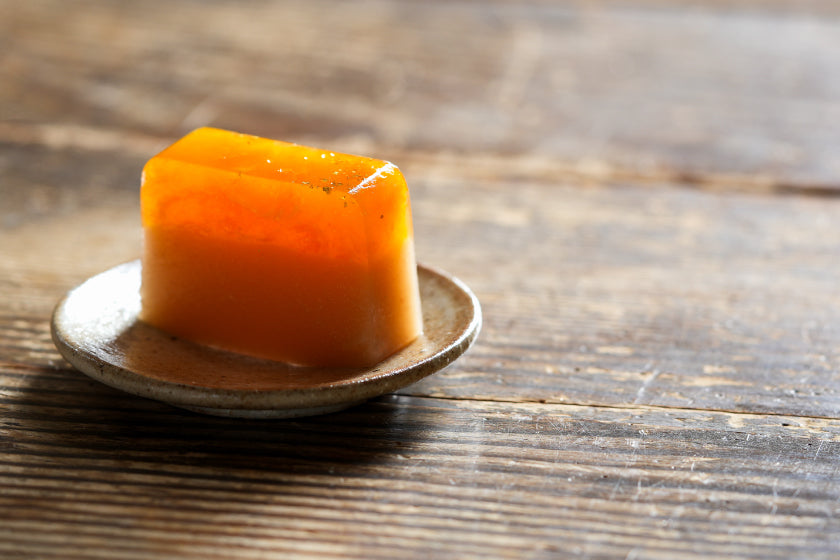
Could the effect of these pyrazine compounds even rival the fragrance of tachibana (mandarin blossom)? We invite you to find out for yourself, paired with "Mikan Yōkan," KOTOSHINA Chaya's seasonal sweet.
■ KOTOSHINA Chaya
【Mikan Yōkan】
For more details, please see here
■ KOTOSHINA's Organic Hojicha

Organic Hojicha
A clean, fragrant hojicha made by slowly roasting tea leaves at high heat. Roasting in a sand-roasting machine allows the heat to penetrate deep into the leaves, bringing out an even richer, more fragrant aroma.
A wonderful companion for cold days.